An interesting article from Dr. Cornelius Hunter's blog, Darwin's God: How Religion Drives Science and Why It Matters:
"One of the reasons evolutionists are convinced their theory is true is because of the way the species compare to each other. The patterns we find amongst the species, say the evolutionists, prove Darwin’s idea beyond a shadow of a doubt. Such arguments pervade the evolution genre—from textbooks to popular literature—but what exactly do they mean? To understand this we must understand the evolutionary mind. These arguments have circuitous histories and baked-in assumptions that are now long forgotten. But they are worth remembering. Here is one example.
In the early years of modern science it was argued that motion was caused by contact between masses. In this mechanical philosophy, influences in the natural world were assumed to be transmitted only by direct mechanical contact. And while this may seem intuitive, the related assumption that there can be no vacuum was less obvious. But it was taken to be a fact. As Rene Descartes wrote in 1644, “some make the mistake of imagining [the heavens] to be a totally empty space … there can be no such vacuum in nature.”
For Descartes the planets moved around the sun because they floated in a cosmic whirlpool. And although Isaac Newton later disproved any such Cartesian whirlpool effect, the Lutheran philosopher and mathematician Gottfried Leibniz later promoted Descartes’ ideas. As Leibniz explained in 1715, the principle of plenitude disproves the existence of vacuums in nature:
Now let us fancy a space wholly empty. God could have placed some matter in it without derogating in any respect from all other things. Therefore he has actually placed some matter in that space; therefore there is no space wholly empty; therefore all is full.
It was a good example of how rationalism can produce certainty in even the most obscure notions. Empirical evidence gives one a healthy respect for nature’s complexities, but thought experiments lead to tidy conclusions..."
"The sad confession which every true scientific man learns to make is, 'I am ignorant; I want to learn'" - Louis Agassiz
The history of science is one of my primary interests. What constitutes science, how scientific opinion and data has changed or appeared, and what sort of influence the whole field of science has on culture, as well as vice versa. Despite all its glory, science is, after all, a very narrow vacuum of understanding when viewed in a historical context. It can only tell us so much, and when the majority of society places upon it burdens and responsibilities it cannot live up to, distortion is inevitable.
Hmm, perhaps a chiseling of definitions is in order. After all, science can apply to different things when used in a general context (i.e., historical science). In the comments on my last article, a debate erupted over whether or not Creation and Evolution are falsifiable and therefore “real science.” I tried to explain that Creation and Evolution are scientific worldviews whose sub-hypotheses constitute predictions, which are falsifiable, which thus constitute “real science.” After thinking things through for awhile and looking things up, I realized why there was so much confusion over what is true science.
Empirical science, technically, is true science. Empirical science is a system of study which deals with observable and repeatable – and therefore testable or experimental – evidence. I suppose we could call it the “useful science,” because it is from empirical science that we get medical advancements. Sounds like the sort of material that should be able to solve all the world’s problems, right? Before you place your faith in it, consider this...
“Evolution is so ‘out there’ that it’s on its way out,” a friend told me. She had many reasons to conclude that it is irrational of some scientists to proclaim that macroevolution is fact. But I’m unable to agree that it is on its way out. After all, since when has being wrong ever warranted removal from discussion in contemporary science and media? There is a sort of philosophic necrophilia permeating the evolutionary realm – evolutionists will cling to the dead body of their hypothesis like William Faulkner’s eccentric character Miss Emily did in A Rose for Emily just because it is too desirable to give up. One atheistic scientist interviewed by Ben Stein said that he couldn’t imagine anything more boring than to believe that the world was created. Au contraire, but have it your way if you must.
But you have no reason to assert that Evolution is science and Creation is not. They are two different models offered to explain what we see in the natural world today. We must admit that a broad generalization is in this mix, as there are different flavors of creationism (i.e., old earth, young earth). Beneath these scientific worldviews are different hypotheses pertaining to specific areas of study. The idea is to see which model best explains the data that we have from research. An example of this method in action is that of the theories used to explain where the electrical current in the earth’s core comes from.
The following satire offers a glimpse into the recent most ridiculous buzz:
It's Official: An Asteroid Wiped Out the Scientists 150 Years Ago
After all, when in doubt, blame an asteroid. No other disaster will do.
When I was a child I once acquired a mainstream “educational” coloring book about dinosaurs. The last page in the book featured two parrots with the caption, “This is what dinosaurs look like today.” But I thought they were called birds, and nobody forced me to think like that. Following that train of thought, I would later conclude that Evolutionists don’t know science from Adam.
Consider this quick test: What is science?
If you answered, “The only unbiased, infallibly truthful source of answers that we know of,” then you are likely of evolutionary upbringing. I don’t mean any personal offense, but you’re also wrong. Science never gives us infallible answers. Essentially, it only asks questions. Science is a procedural tool used to discern evidence about the workings of the natural world (the key word being discern). Colloquially speaking, the definition of science is more inclusive than that, but let us be technical here. After all, the beginning of a good education in a subject should be to define the subject, shouldn’t it? [Insert the next few thousand Socratic questions here]
"Norwegian Shooter’s latest comment got me thinking about my journey from atheism to Christianity. As I look back on that journey, I realize how similar my experience was to that of Dr. Esther Su. As a scientist, I have to believe in things that are rational. As a result, when a girl who I wanted to date kept talking to me about Christianity, I dismissed it, because the brainwashing I had received from authors like Bertram Russell indicated that Christianity was not rational. Of course, as is the case with most brainwashing, that turned out to be 100% false, but it took me a while to figure that out.
This girl eventually took me to a debate between an atheist who was a scientist and a Christian who was a scientist. The debate was interesting, but what was more interesting was that the Christian gave several references that I could read to learn more about the shocking idea that Christianity is rational. I reluctantly looked into some of those references, and eventually, I learned that atheists had lied to me most of my life..."
We could spend our entire lifetimes drinking in the evidence for the creative GOD of the Bible within the finite basin of our universe and still never find it dry - the fingerprint of an infinite Designer, no doubt! Are you not impressed by the design of the giraffe, that can bow and raise its long neck quickly without losing consciousness? Look to the bombardier beetle, with its built in arsenal of chemical weaponry. Not impressed? Look to the smallest unit of living matter, the cell. Not impressed? Look to the complex symbolism within the Hebrew and Chinese languages. Look to the precise chemistry of the atmosphere, the way a fish breathes under water, the way the immune system fights like a trained army, and the way a mammal nurses its young. Still not impressed? Look to the heavens.
Behold a system so mathematically precise that you can fast forward and rewind an image of its motions with modern software.
"The heavens are telling the glory of GOD; And their expanse is declaring the work of His hands. Day to day pours forth speech, and night to night reveals knowledge. There is no speech, nor are there words; Their voice is not heard. Their line has gone out through all the earth, and their utterances to the end of the world." ~ Psalm 19:1-4
The actual Hebrew words in those sentences that are often translated as "declaring" or "telling" are çâphar (ספד)and nâgad (נגד). The meaning of çâphar is
"to score with a mark as a tally or record, i.e. (by impl.) to inscribe, and also to enumerate; intens. to recount, i.e. celebrate:-commune, (ac-) count, declare, number, + penknife, reckon, scribe, shew forth, speak, talk, tell (out), writer." Strong's Concordance.
Ah, doesn't that sound astronomical?
The word çâphar is the same word used in Job 12:8, 28:27 ("Then He saw it and declared it; He established it and also searched it out"), 1 Chronicles 16:24, Psalm 78:6 ("That the generation to come might know, even the children yet to be born, that they may arise and tell them to their children...") and many other verses.
The meaning of nâgad is
"to front, i.e. stand boldly out opposite; by impl. (causat.) to manifest; fig. to announce (always by word of mouth to one present); spec. to expose, predict, explain, praise:-bewray, x certainly, certify, declare (-ing), denounce, expound, x fully, messenger, plainly, profess, rehearse, report, shew (forth), speak, x surely, tell, utter." Strong's Concordance.
The word nâgad is used in Genesis 41:24 (when Pharaoh told Joseph about his dream, "I told it to my magicians, but there was no one who could explain it to me"), Esther 4:8, Job 31:37, Isaiah 3:9, 21:6, 41:22 ("Let them bring forth and declare to us what is going to take place; as for the former events, declare what they were, that we may consider them and know their outcome. Or announce what is coming..."), and many other passages.
Read Psalm 19 with this fuller understanding of the beautiful Hebrew words çâphar (ספד)and nâgad (נגד) and no longer does it simply mean that the starry sky is an impressive display to reflect GOD's glory. The celestial bodies have been placed there with a mission to communicate and verify the entire saga of salvation.
"Then GOD said, 'Let there be lights in the expanse of the heavens to separate the day from the night, and let them be for signs and for seasons and for days and years...'" ~ Genesis 1:14
The Hebrew word in that passage often translated as "signs" is 'ôwth (אות), which means
"a signal (lit. or fig.), as a flag, beacon, monument, omen, prodigy, evidence, etc.:-mark. miracle, (en-)sign, token." Strong's Concordance
Before I delay any longer, I really must let you see what one Christian lawyer on a quest to understand the Star of Bethlehem discovered along the way.
Hint: Remember that YAHWEH named the stars, not man (see Job 9 and Amos 8) - different cultures have told stories to go along with the stars, but they haven't changed the names and their meanings. Then recall the great sign that appeared in heaven in Revelation 12 about the woman clothed with the sun; the moon at her feet and a crown of 12 stars on her head. Now prepare to realize that there is something historically significant about December 25th, and no, it has nothing to do with pagans, Santa Clause, or even a manger.
Introducing, Frederick A. Larson...
Post Scriptum to skeptics - Still not impressed? There's more...
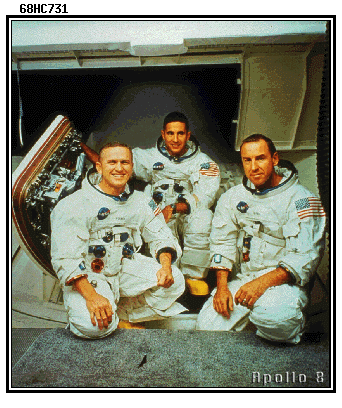
"We are now approaching lunar sunrise and, for all the people back on Earth, the crew of Apollo 8 has a message that we would like to send to you.
"In the beginning God created the heaven and the earth. And the earth was without form, and void; and darkness was upon the face of the deep. And the Spirit of God moved upon the face of the waters. And God said, Let there be light: and there was light. And God saw the light, that it was good: and God divided the light from the darkness..."
Be sure to remember this priceless snippet at the end:
"When a whining (Mother of Atheism) Madalyn Murray O'Hare attempted to sue NASA for the above, the courts tossed the case out because it was out of their jurisdiction. Funny."
-UPDATE-
This subject was also written about by Stacy McDonald: